
Whey vs casein: digestion speed, leucine, and which to buy
Whey and casein are both milk proteins pulled from the same liquid. Whey digests fast and peaks in your blood within about an hour; casein clots in stomach acid and releases amino acids over several hours. Matched for total protein across a day, neither builds more muscle.
Whey vs casein: same milk, two different clocks
Cow's milk protein is roughly 80% casein and 20% whey. Cheesemaking separates them — the curd is casein, the liquid drained off is whey — and almost everything that distinguishes the two powders traces back to that split.
Whey stays soluble at stomach pH. It empties quickly, arrives in the small intestine as a bolus, and pushes blood amino acids to a sharp peak somewhere around 45 to 90 minutes after you drink it, then back toward baseline within a couple of hours.
Casein does the opposite. In acid it precipitates into a soft gel — the same clotting that makes cheese — and that gel has to be broken down before it can leave the stomach. The amino acid curve is lower and much flatter, stretched across roughly four to seven hours depending on the dose and what else is in the meal.
So whey protein vs casein isn't an argument about quality. Both are complete proteins carrying all nine essential amino acids. It's an argument about release rate.
Leucine is why whey owns the training window
Muscle protein synthesis is triggered largely by leucine, and it responds to how fast leucine arrives, not only to how much eventually shows up. Whey is unusually leucine-dense — roughly 10–11% of its protein by weight — so a 25 g protein serving delivers something near 2.5–3 g of leucine in one hit. That's the range generally described as enough to fully switch on the synthesis response in a healthy adult.
Casein sits closer to 8–9% leucine, and it releases that leucine slowly enough that blood levels never spike as hard. Same total, gentler curve.
If the shake is doing a job near training, whey does that job better. How tightly you have to time it is a separate question, and a less urgent one than most people assume — see protein timing around workouts.
Casein earns its place overnight and across long gaps
The gel is a feature whenever the next meal is far away. Sleep is the obvious case: seven or eight hours with nothing coming in, opened by a powder built to trickle. A long afternoon with no break behaves the same way.
Slow gastric emptying also makes casein more filling than whey for most people, which matters more in a fat-loss phase than in a bulk.
Two forms are worth telling apart. Micellar casein keeps the native micelle structure intact, mixes thick, and gels hardest — the slowest option on the shelf. Calcium or sodium caseinate is processed to stay soluble, mixes thin, and digests somewhat faster. Milk protein concentrate is simply both proteins together in milk's natural ratio, so it behaves like mostly-casein with a whey head start.
Whey protein isolate vs whey protein concentrate is a filtration difference
Concentrate and isolate are the same protein filtered to different degrees.
- Concentrate typically runs 70–80% protein by weight, with the remainder as lactose, milk fat, and minerals. Cheaper products in the category can run well below that range, so read the nutrition panel rather than the front of the tub.
- Isolate is filtered past 90% protein, which strips most of the lactose and nearly all the fat — usually under a gram of lactose per serving.
- Hydrolysate is isolate partially broken into shorter peptides. It absorbs marginally faster and tastes noticeably bitter.
What the extra filtration buys is lactose removal and a few more grams of protein per scoop, not a different result in the mirror. If dairy sugar gives you trouble, isolate solves a real problem. If it doesn't, concentrate at the same daily protein total does the same work.
Plant powders need pea plus rice, not pea alone
Pea protein is rich in lysine and short on methionine. Rice protein is the mirror image — adequate methionine, low lysine. Blended, often near 70/30 pea to rice, they cover each other and the amino profile stops having a hole in it. The same logic runs through whole foods, which is why complete protein foods in plant-heavy diets tend to be combinations.
Leucine is the other gap. Pea runs about 8% leucine, so reaching the same 2.5–3 g takes roughly a third more powder than whey does. Scoop bigger rather than more often.
Soy isolate is the one common single-source plant powder with a complete profile, absorbed at a moderate rate — closer to milk protein than to either extreme.
Types of protein powder, side by side
| Powder | Protein by weight | Digestion | Leucine per 25 g protein | Where it fits |
|---|---|---|---|---|
| Whey concentrate | ~70–80% | Fast, peaks near 1 hour | ~2.5–3 g | Everyday use, around training |
| Whey isolate | 90%+ | Fast | ~2.5–3 g | Lactose sensitivity, tight calorie budget |
| Whey hydrolysate | 90%+ | Fastest | ~2.5–3 g | Marginal gain, bitter taste |
| Micellar casein | ~80% | Slow, 4–7 hours | ~2–2.3 g | Overnight, long gaps, appetite control |
| Calcium caseinate | ~90% | Slow-ish | ~2–2.3 g | Casein that mixes thin |
| Pea + rice blend | ~75–85% | Moderate | ~2–2.2 g | Dairy-free, needs both sources |
| Soy isolate | ~90% | Moderate | ~2–2.1 g | Dairy-free from one source |
Daily total first, powder type a distant second
Hit your protein target for the day, spread it across three or four feedings, then argue about powder. A lifter well under target with perfectly timed whey loses to one eating enough with the cheapest concentrate on the shelf. How much protein per day sets that number, and everything on this page is a rounding error next to it.
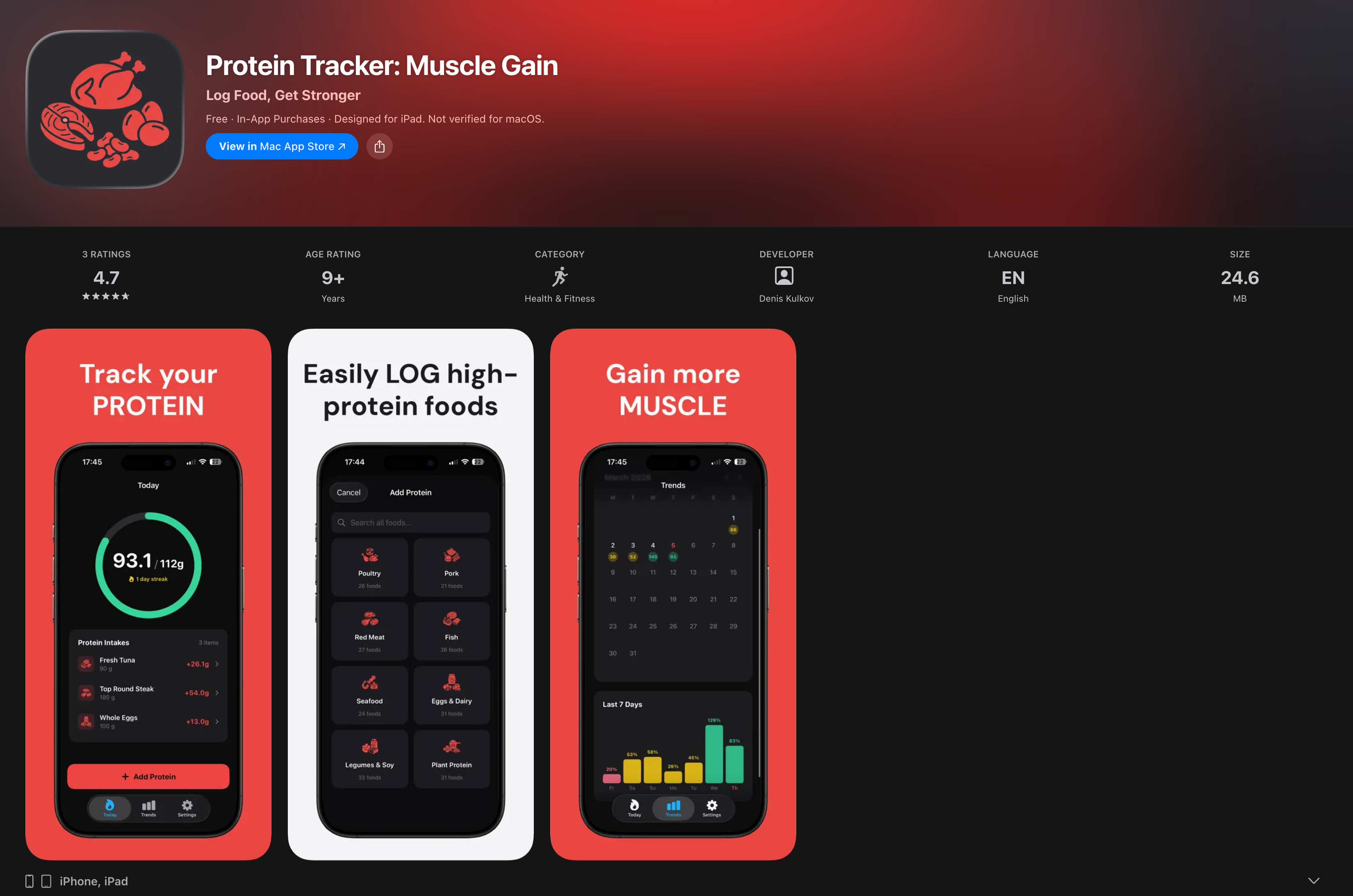
Powder is one slice of the total, and it stays honest when a scoop is counted the same way as chicken — Protein Tracker, a protein tracking app for iPhone, puts both into one daily number, so powder isn't a separate spreadsheet.
Choose on constraints, not on marketing copy. Dairy is fine and you train in the morning: concentrate. Lactose is a problem: isolate. Long overnight gap, or hunger you want blunted: casein. No dairy at all: a pea-rice blend, sized up. Running whey by day and casein at night works fine, but that's optimization, not a requirement.
FAQ
Is whey or casein better for building muscle?
Whey has the edge in the hours right after a session because it delivers leucine faster and higher. Across a full day with protein intake matched, the gap between them shrinks to near nothing. Total grams is the variable that actually moves size.
Can I take whey and casein together?
Yes, and milk protein concentrate is that mix sold in one bag. Combining gives a fast rise from the whey and a longer tail from the casein, which is a reasonable default if you only want to own one tub.
Is casein vs whey protein different for fat loss?
Casein tends to be more filling because it leaves the stomach slowly, which helps with appetite in a deficit. Neither one burns fat. Both protect muscle during a cut as long as total protein stays high.
Do I need whey isolate if I'm lactose intolerant?
Usually it's enough. Isolate typically leaves under a gram of lactose per serving, which most people with lactose intolerance tolerate without symptoms. If even that bothers you, a hydrolysate or a plant blend removes the question.
How much protein powder should I use per day?
Enough to close the gap between what you eat and what you need, which for most lifters is one or two scoops. Whole food should carry the bulk of the total — powder is convenience, not a nutritional requirement.
Free Protein tools
- Chicken Breast Calorie CalculatorEnter chicken breast weight, whether you weighed it raw or cooked, skin and cooking method to see calories, protein, fat, carbs and the matching raw-to-cooked weight.
- Creatine Dosage CalculatorEstimate grams per day, loading-phase split doses, time to saturation, and tub supply for the question: how much creatine should I take?
- Daily Protein Requirement CalculatorEstimate how much protein a day you should consume using your body weight, age, activity level and goal. See the g/kg basis and a practical per-meal split.
- Egg Protein CalculatorChoose an egg size, quantity, part and cooking method to see protein, calories, full macros and the share of your daily protein target.
- High Protein Meal PlannerPlan a high protein meal planner split from your daily target. Choose 2 to 6 meals and a dietary preference to see grams per meal and example foods.
- Macros CalculatorUse this macros calculator to estimate daily calories and grams of protein, carbohydrates and fat for your chosen goal and macro split.
- Protein CalculatorUse this protein calculator to estimate a daily protein range from your body weight, activity level and goal, with simple per-meal splits.
- Protein Foods ChartFilter a protein foods chart by category, serving basis and minimum protein per serving, then sort the foods to find practical options to log.
- Protein in Chicken CalculatorEstimate the protein in a chicken portion using its cut, serving weight and raw or cooked basis.
- Protein in Fish CalculatorEnter a fish type and serving weight to convert protein in fish per 100g into tracker-ready grams for your portion.
- Protein in Lentils CalculatorEstimate the protein grams in a lentil serving by cooked weight. The result uses the listed boiled-lentil value and identifies when a dry value is unavailable.
- Protein in Meat ChartChoose a meat, enter its weight and select a raw or cooked basis to compare the protein grams in common meats.
- Protein in Nuts ChartChoose a nut type, serving size and minimum protein filter to compare protein grams across nuts and seeds.
- Protein Intake CounterTrack your daily protein target with quick-add portions or a custom amount. See your running total, grams remaining and entries in one place.