How much protein in an egg, and how many eggs hit 30 g
A large egg has about 6.3 grams of protein — 3.6 g in the white, 2.7 g in the yolk. How much protein in an egg comes down to its size class, not how you cook it: a medium runs about 5.5 g, a jumbo about 7.9 g.
How much protein in an egg, by size
How many grams of protein in an egg depends first on its size class, and US egg sizes are graded by minimum net weight per dozen in the shell — not by any individual egg. A dozen large has to weigh at least 24 oz; a dozen jumbo, at least 30 oz. Shell accounts for roughly 10–11% of that weight, so the edible portion of a large egg lands near 50 g.
Whole egg runs about 12.6 g of protein per 100 g of edible egg. Apply that density to each size class and you get the numbers below.
| Egg size | Min. weight per dozen | Edible egg | Protein | Calories |
|---|---|---|---|---|
| Small | 18 oz | ~38 g | ~4.8 g | ~54 |
| Medium | 21 oz | ~44 g | ~5.5 g | ~63 |
| Large | 24 oz | ~50 g | ~6.3 g | ~72 |
| Extra-large | 27 oz | ~56 g | ~7.1 g | ~80 |
| Jumbo | 30 oz | ~63 g | ~7.9 g | ~90 |
Because grading happens per dozen, eggs inside a single carton still vary by a gram or two. Treat the figures as averages.
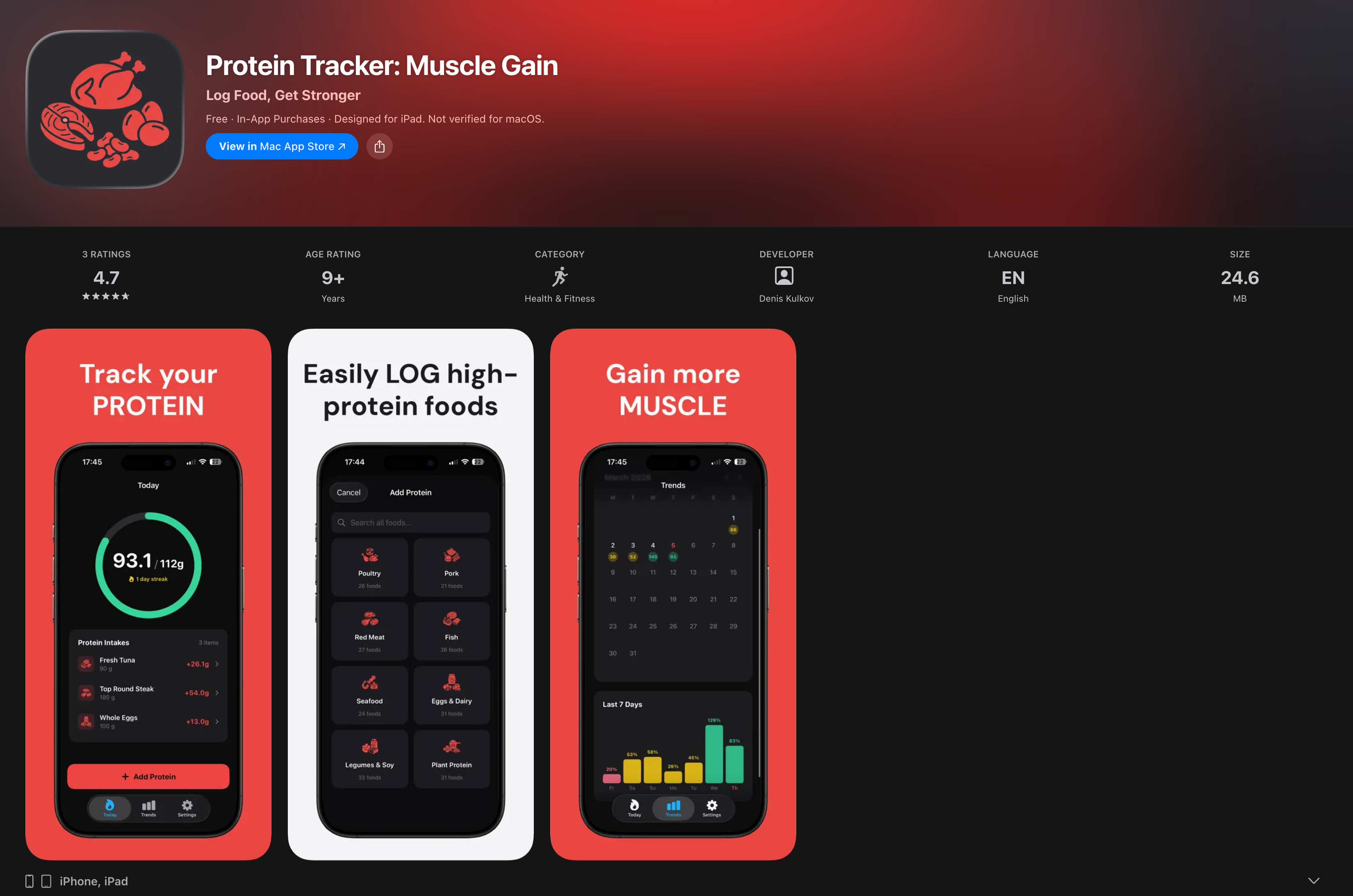
Size is also where hand-counting quietly goes wrong. Someone memorizes "two eggs = 12 g," then buys whatever's cheapest that week, and the real total drifts anywhere from 9.6 g (two smalls) to 15.8 g (two jumbos). Protein Tracker is a protein tracking app for iPhone, and a saved food entry keeps "two large eggs" at the same 12.6 g every morning instead of getting re-estimated.
White vs yolk: where the protein actually sits
A large egg white weighs about 33 g and carries 3.6 g of protein for roughly 17 calories, with essentially no fat. The yolk weighs about 17 g and carries 2.7 g of protein for roughly 55 calories, plus all 5 g of the egg's fat.
That means the white holds about 57% of the protein in an egg while accounting for under a quarter of its calories. The yolk is the fat-and-micronutrient half: around 147 mg of choline, most of the vitamin D and B12, and the lutein and zeaxanthin that give it color.
Boiling, frying, and scrambling don't change the grams
The protein in eggs survives every standard cooking method. Heat denatures it — the coiled chains unfold and set — but denaturing isn't destroying. A hard-boiled large egg, a poached one, and a scrambled one all deliver the same ~6.3 g. What changes is everything you cook it in: a teaspoon of butter adds about 34 calories and no protein, and a splash of milk in scrambled eggs adds a few tenths of a gram.
Cooking actually improves what you absorb. Raw egg protein digests at roughly half efficiency; cooked egg protein digests at over 90%. Raw whites also contain avidin, which binds biotin and blocks its absorption, and heat deactivates it. There's no protein argument for raw eggs.
How many eggs make 30 grams of protein
Five large eggs get you about 31.5 g, at roughly 360 calories. That's steep for a single macro target, so most people building a high-protein breakfast split the difference:
- 3 whole large eggs + 4 whites: ~33 g protein, ~285 calories
- 2 whole large eggs + 6 whites: ~34 g protein, ~250 calories
Whether 30 g in one sitting is the right move depends on your daily total — see how much protein you need per day.
Egg whites vs whole eggs on a calorie budget
Per 100 calories, egg whites deliver about 21 g of protein. Whole eggs deliver about 8.8 g. The yolk on its own manages about 5 g. If you're working under a calorie ceiling, whites win on efficiency, and that's the entire case for them.
The case against going all-white is that the yolk holds nearly all of the egg's micronutrients — whites are basically protein and water. Carton liquid egg whites run about 5 g of protein per 3 tablespoons for 25 calories, which is the least tedious way to buy them.
On cholesterol: US dietary guidance dropped the numeric 300 mg/day cap in 2015, while still advising that intake stay low. A large yolk has about 186 mg.
Eggs vs chicken protein, and how egg quality compares
On density, chicken wins decisively. Cooked skinless chicken breast has about 31 g of protein per 100 g for 165 calories — the protein of five large eggs at less than half the calories.
On quality, eggs are the reference standard. Whole egg scores the maximum 1.00 on PDCAAS, the same ceiling as milk and whey. On the newer DIAAS scale, whole cooked egg is commonly cited around 113 — in the same top tier as milk and whey. Chicken is a high-quality complete protein too, but it isn't part of the classic PDCAAS/DIAAS reference tables the way dairy and egg are. Egg protein carries every essential amino acid in usable ratios, which is why it's the benchmark other complete protein foods get measured against.
The gap that matters for lifters is leucine. A large egg has roughly 0.5 g, so a two-egg breakfast lands near 1 g — well under the 2–3 g often cited as the threshold for maximizing muscle protein synthesis in one meal. Pair eggs with Greek yogurt or milk, or add a third and fourth egg.
Protein in common egg dishes
- Hard-boiled large egg: ~6.3 g
- Two fried large eggs: ~12.6 g
- Plain three-egg omelet: ~19 g
- Three-egg omelet with 1 oz cheddar: ~26 g
- Egg-white omelet from 4 large whites: ~14.4 g
- Two eggs with two strips of bacon: ~19 g
- Egg salad sandwich (2 eggs, 2 slices bread): ~17 g
- Two deviled egg halves: ~6.3 g
FAQ
How many grams of protein are in a boiled egg?
A boiled large egg has about 6.3 g of protein, the same as that egg raw, fried, or scrambled. Boiling sets the protein without removing any of it. A boiled jumbo gets you closer to 7.9 g, a boiled medium closer to 5.5 g.
How much protein is in two eggs?
Two large eggs give you about 12.6 g. Two mediums come to roughly 11 g and two jumbos to about 15.8 g — nearly a 5-gram spread that adds up over a week of breakfasts.
Do egg whites have more protein than yolks?
Per egg, yes: 3.6 g in the white versus 2.7 g in the yolk. But gram for gram the yolk is actually the more concentrated source — about 16% protein by weight versus 11% for the white, since the white is mostly water. The white only wins on total grams because it weighs about twice as much, and per calorie it's roughly four times more protein-dense.
Is it better to eat eggs or chicken for protein?
For hitting a high target on limited calories, chicken breast is more efficient by a wide margin. Eggs win on cost, prep time, and micronutrients, and their amino acid profile is at least as good. Most people rotate both along with other high protein foods through the day.
Free Protein tools
- Chicken Breast Calorie CalculatorEnter chicken breast weight, whether you weighed it raw or cooked, skin and cooking method to see calories, protein, fat, carbs and the matching raw-to-cooked weight.
- Creatine Dosage CalculatorEstimate grams per day, loading-phase split doses, time to saturation, and tub supply for the question: how much creatine should I take?
- Daily Protein Requirement CalculatorEstimate how much protein a day you should consume using your body weight, age, activity level and goal. See the g/kg basis and a practical per-meal split.
- Egg Protein CalculatorChoose an egg size, quantity, part and cooking method to see protein, calories, full macros and the share of your daily protein target.
- High Protein Meal PlannerPlan a high protein meal planner split from your daily target. Choose 2 to 6 meals and a dietary preference to see grams per meal and example foods.
- Macros CalculatorUse this macros calculator to estimate daily calories and grams of protein, carbohydrates and fat for your chosen goal and macro split.
- Protein CalculatorUse this protein calculator to estimate a daily protein range from your body weight, activity level and goal, with simple per-meal splits.
- Protein Foods ChartFilter a protein foods chart by category, serving basis and minimum protein per serving, then sort the foods to find practical options to log.
- Protein in Chicken CalculatorEstimate the protein in a chicken portion using its cut, serving weight and raw or cooked basis.
- Protein in Fish CalculatorEnter a fish type and serving weight to convert protein in fish per 100g into tracker-ready grams for your portion.
- Protein in Lentils CalculatorEstimate the protein grams in a lentil serving by cooked weight. The result uses the listed boiled-lentil value and identifies when a dry value is unavailable.
- Protein in Meat ChartChoose a meat, enter its weight and select a raw or cooked basis to compare the protein grams in common meats.
- Protein in Nuts ChartChoose a nut type, serving size and minimum protein filter to compare protein grams across nuts and seeds.
- Protein Intake CounterTrack your daily protein target with quick-add portions or a custom amount. See your running total, grams remaining and entries in one place.