How to get 100 grams of protein a day, plus 150 g and 200 g plans
The short answer for how to get 100 grams of protein a day: four eating occasions of about 25 g each, or three meals of 30 g plus one high-protein snack. The reliable route is a fixed protein anchor at breakfast, two repeatable main meals, and trading carb snacks for dairy or a shake.
What 100 grams of protein actually looks like
It isn't a plate. It's a day's worth of food, and it's less volume than people expect. Laid out on one counter, 100 g of protein is roughly:
- One 6 oz (170 g) cooked chicken breast — about 52 g
- Three large eggs — about 18 g
- One 170 g cup of plain nonfat Greek yogurt — about 17 g
- One cup of milk — about 8 g
- One ounce of cheddar — about 7 g
That's 102 g, and it fits in two hands. The difficulty isn't volume, it's distribution — spread across a day with bread, rice, and vegetables around them, those items stop registering as protein and register as lunch.
One measurement note. Chicken breast runs roughly 23 g of protein per 100 g raw and about 31 g per 100 g cooked, because water leaves during cooking — the protein didn't change, the denominator did. Package labels are raw, restaurant portions are cooked, and mixing the two is the most common error here.
How to get 100 grams of protein a day
Breakfast — 22 g
- 3 large eggs (18 g)
- 1 slice whole-grain toast (4 g)
Lunch — 36 g (running total: 58 g)
- 1 can tuna in water, drained, ~110 g (28 g)
- 2 slices bread (8 g)
Snack — 17 g (75 g)
- 170 g plain nonfat Greek yogurt (17 g)
Dinner — 31 g (106 g)
- 100 g cooked 93% lean ground beef (26 g)
- Rice and vegetables (5 g)
Landing at 106 instead of exactly 100 is deliberate. Estimates drift down, not up, so a plan that lands on the number on paper lands under it in the kitchen.
How to get 150 grams of protein a day
It's the plan above plus one shake and a larger dinner. Not a different lifestyle.
Breakfast — 25 g
- 200 g plain nonfat Greek yogurt (20 g)
- 40 g dry oats (5 g)
Lunch — 49 g (74 g)
- 140 g cooked chicken breast (43 g)
- 1 cup cooked rice (4 g) and vegetables (2 g)
Snack — 25 g (99 g)
- 1 scoop whey protein in water (25 g)
Dinner — 42 g (141 g)
- 140 g cooked salmon (35 g)
- Potatoes (4 g), broccoli (3 g)
Evening — 12 g (153 g)
- 100 g 2% cottage cheese (12 g)
What changes is that no meal gets to be a low-protein meal. One pasta bowl, one salad without meat, and you're 40 g behind with nowhere left to put it.
How to get 200 grams of protein a day
Here the three-meal structure breaks. You need five eating occasions.
Breakfast — 39 g
- 4 large eggs (24 g)
- 150 g plain nonfat Greek yogurt (15 g)
Mid-morning — 32 g (71 g)
- 1 scoop whey in 250 ml milk (24 g + 8 g)
Lunch — 58 g (129 g)
- 170 g cooked chicken breast (52 g)
- 1 cup rice (4 g) and vegetables (2 g)
Afternoon — 26 g (155 g)
- 1 cup (226 g) 2% cottage cheese (26 g)
Dinner — 52 g (207 g)
- 170 g cooked 93% lean ground beef (44 g)
- Potato (5 g), broccoli (3 g)
Calories become the constraint here, which is why the plan leans on lean beef, poultry, white fish, and nonfat dairy — fattier cuts hit the same protein with hundreds more calories. Every occasion is load-bearing too: skip the shake and the cottage cheese and you finish at 149 g.
Which target is yours is a separate question. Commonly cited guidance for people training for muscle sits near 1.6–2.2 g per kg of body weight, putting 100 g around a 60 kg lifter and 200 g with large athletes or dieters protecting muscle. Pick your number from how much protein you actually need first.
Three mechanics that make a high target work
Anchor a fixed amount at breakfast
Decide on 30–40 g before mid-morning and don't renegotiate. Debt compounds: a 6 g bowl of cereal leaves two meals owing 94 g. Eggs, Greek yogurt, cottage cheese, and a shake all clear 20 g with almost no cooking.
Keep two meals on autopilot
People who hit a protein goal consistently aren't more disciplined, they're less creative. Two default meals you build without deciding anything remove most of the daily failure points. Vary dinner; leave lunch alone.
Trade snack calories for snack grams
This is where the missing grams usually are, and nothing about your meals has to move.
| Instead of | Eat | Protein change |
|---|---|---|
| Handful of almonds (28 g) — 6 g | 1 cup 2% cottage cheese — 26 g | +20 g |
| Banana — 1 g | 200 g nonfat Greek yogurt — 20 g | +19 g |
| Granola bar — 4 g | 1 scoop whey in water — 25 g | +21 g |
| Small bag of chips — 3 g | 100 g deli turkey + a string cheese — 25 g | +22 g |
Two of those swaps cover the distance between a 100 g day and a 140 g day. For more options, work from a list of high-protein foods and pick the ones you'd eat unprompted.
Why estimates run low
Ask someone eating "high protein" to guess yesterday's total and the guess usually lands well above the real number, often by the size of a whole meal. The gap is structural, not careless:
- Raw versus cooked weight. The label on the package and the food on the plate are different weights.
- "A chicken breast" isn't a unit. Supermarket breasts run from about 110 g to 250 g — a 30+ gram protein swing depending which piece lands on your plate.
- Mixed dishes hide portions. The chicken in a stir-fry or a burrito is usually 60–90 g of meat, not 170 g.
- Small amounts go uncounted both ways. The milk in your coffee counts; the handful of chicken you called lunch was less than you think.
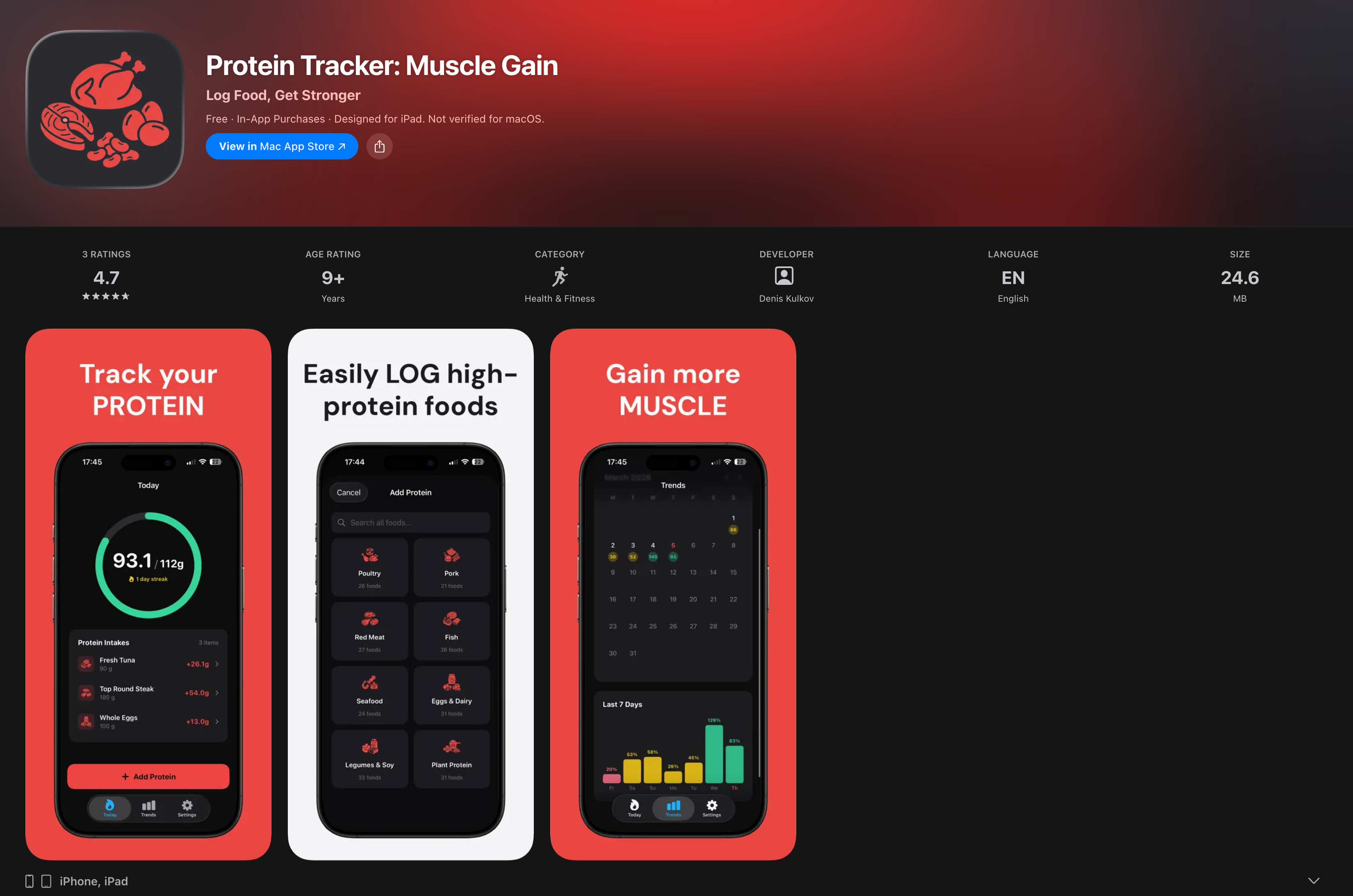
So the honest answer for a high target is to write it down. A running daily total does the arithmetic these plans otherwise demand of you — instead of remembering lunch was 49 g and guessing at dinner, you see 74 with 76 to go and choose dinner accordingly. Protein Tracker is a protein tracking app for iPhone that keeps that number in front of you as the day goes.
You can track protein intake on paper just as well. The requirement is only that the number exists before dinner rather than after.
FAQ
What does 100 grams of protein look like in one day?
Four modest servings. A three-egg breakfast, a can of tuna at lunch, a cup of Greek yogurt in the afternoon, and a palm-sized portion of meat or fish at dinner gets you there.
Can I hit 100 grams of protein a day without protein powder?
Yes. Eggs, dairy, poultry, fish, and legumes cover 100 g without a scoop of anything. Powder starts earning its place around 150 g and becomes genuinely useful at 200 g, because it adds 25 g without adding a meal.
Does it matter how I split protein across meals?
Spreading it out is practical more than critical. Even servings across three or four meals are easier to hit than one enormous dinner, and the per-meal ceiling is still debated — more in how much protein the body uses at once. Daily total remains the number that matters most.
How do I eat more protein without eating more calories?
Swap the source rather than adding food. Nonfat Greek yogurt for regular, 93% lean beef for 80%, chicken breast for thigh — each holds protein steady while cutting fat calories. Shrinking the starch and enlarging the meat does the same inside a meal.
Free Protein tools
- Chicken Breast Calorie CalculatorEnter chicken breast weight, whether you weighed it raw or cooked, skin and cooking method to see calories, protein, fat, carbs and the matching raw-to-cooked weight.
- Creatine Dosage CalculatorEstimate grams per day, loading-phase split doses, time to saturation, and tub supply for the question: how much creatine should I take?
- Daily Protein Requirement CalculatorEstimate how much protein a day you should consume using your body weight, age, activity level and goal. See the g/kg basis and a practical per-meal split.
- Egg Protein CalculatorChoose an egg size, quantity, part and cooking method to see protein, calories, full macros and the share of your daily protein target.
- High Protein Meal PlannerPlan a high protein meal planner split from your daily target. Choose 2 to 6 meals and a dietary preference to see grams per meal and example foods.
- Macros CalculatorUse this macros calculator to estimate daily calories and grams of protein, carbohydrates and fat for your chosen goal and macro split.
- Protein CalculatorUse this protein calculator to estimate a daily protein range from your body weight, activity level and goal, with simple per-meal splits.
- Protein Foods ChartFilter a protein foods chart by category, serving basis and minimum protein per serving, then sort the foods to find practical options to log.
- Protein in Chicken CalculatorEstimate the protein in a chicken portion using its cut, serving weight and raw or cooked basis.
- Protein in Fish CalculatorEnter a fish type and serving weight to convert protein in fish per 100g into tracker-ready grams for your portion.
- Protein in Lentils CalculatorEstimate the protein grams in a lentil serving by cooked weight. The result uses the listed boiled-lentil value and identifies when a dry value is unavailable.
- Protein in Meat ChartChoose a meat, enter its weight and select a raw or cooked basis to compare the protein grams in common meats.
- Protein in Nuts ChartChoose a nut type, serving size and minimum protein filter to compare protein grams across nuts and seeds.
- Protein Intake CounterTrack your daily protein target with quick-add portions or a custom amount. See your running total, grams remaining and entries in one place.